How to ship ai powered recommendation systems without breaking the bank
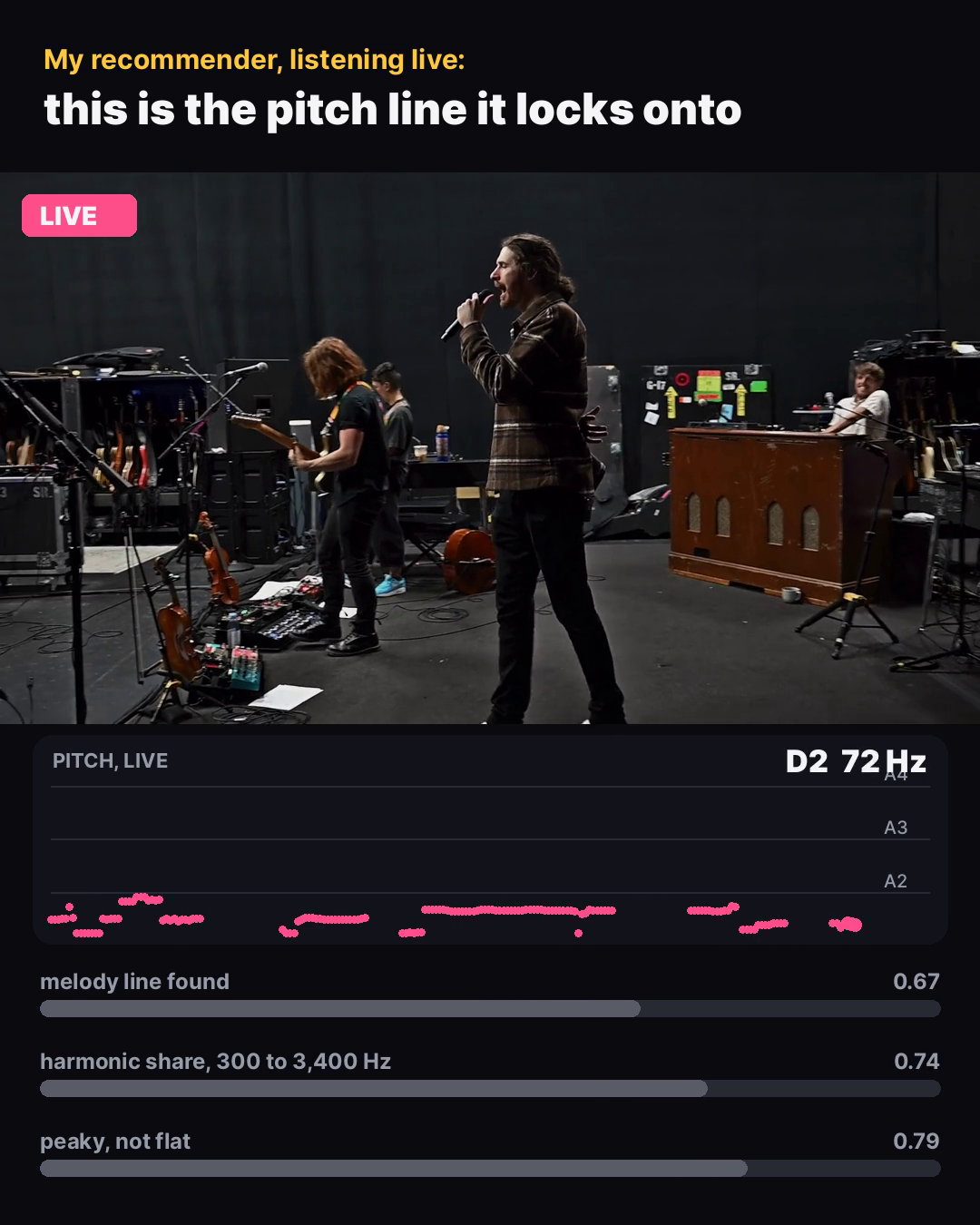
Hozier, Too Sweet, with a live vocal analysis on 600 hand-labelled tracks, a zero-shot CLAP prior matched a supervised model trained on three embeddings. It costs 38 ms per track, passed a promotion gate against the old model, and moved completion rate 4% in a 30-day holdout.
Give the people what they want
I don't know about you, but I love a good vocalist. I'm bold enough to say most people do too. But AI Inference aint cheap. So heres how to solve the cost problem at scale. Most engineering teams know they need to cut inference cost for ai generative recommendation or personalization systems (link). I had the same shape of problem at a smaller size: 1.2M tracks need a vocal-presence label, re-scored nightly, and a heavy model per track was not affordable. This is how I picked the detector, gated it, and measured what it did in the ranker.
Hozier, Too Sweet, with my vocal analysis running live, and the four-way comparison
Reference links
Three sources per row: a domain-research paper, Spotify's own best example, and a cross-validation source from outside Spotify so no single company's framing becomes the whole picture. Read the research link before building; cite the Spotify link in the post's first paragraph; use the cross-validation link to show the problem is general.
Requirements
Accuracy, grouped CV
- Domain research
- Do LLM-judges align with human relevance in Cranfield-style recommender evaluation? (Spotify, 2025)
- Industry leading
- Spotify Research blog, Evaluation tag
- Cross validation
- The MTG-Jamendo dataset for automatic music tagging (UPF, ISMIR 2019), the standard open eval set with artist-grouped splits
Latency and cost
- Domain research
- Deploying Semantic ID-based Generative Retrieval for Large-Scale Podcast Discovery at Spotify (2026)
- Industry leading
- Spotify x NVIDIA: generative recommendation inference on TensorRT-LLM (Oct 2026)
- Cross validation
- Meta, Actions Speak Louder than Words: trillion-parameter sequential transducers for generative recommendations (HSTU, ICML 2024)
Reproducibility
- Domain research
- LAION CLAP repo and paper
- Industry leading
- laion/clap-htsat-fused model card
- Cross validation
- Google, Rules of Machine Learning (Zinkevich): the engineering-practice baseline every FAANG ML team cites
Promotion gate, ranker evidence
- Domain research
- Why Spotify separates personalization and experimentation stacks (Jan 2026)
- Industry leading
- Confidence by Spotify: experimentation platform
- Cross validation
- Netflix, Success Stories from a Democratized Experimentation Platform (2020)
Prior vs intent
- Domain research
- Mehrotra et al., contextual bandits and multi-stakeholder sequencing at Spotify (2021)
- Industry leading
- Shivam Verma, Personalization in the Era of LLMs (Spotify, 2026)
- Cross validation
- YouTube, Recommending What Video to Watch Next: a multitask ranking system (RecSys 2019)
Add-ons
Session intent flags
- Domain research
- Mehrotra, contextual bandits for session intent (Spotify)
- Industry leading
- Talk to Spotify (Jul 2026)
- Cross validation
- YouTube multitask ranking: engagement vs satisfaction objectives per session (RecSys 2019)
Vocal features as ranker inputs
- Domain research
- Universal music representations? Evaluating foundation models on world music corpora (2025)
- Industry leading
- Spotify Research: Hypothesis-driven shelf generation (Sep 2026)
- Cross validation
- MERT: acoustic music understanding with large-scale self-supervised training (QMUL / ByteDance, ICLR 2024)
Vocal embedding, PCA via Thunderdome
- Domain research
- Semantic IDs for joint generative search and recommendation (Spotify, RecSys 2025)
- Industry leading
- Spotify semantic-ID retrieval in production for podcasts (2026)
- Cross validation
- Pinterest, PinSage: graph convolutional networks for web-scale recommenders (KDD 2018) and PinnerSage multi-modal user embeddings (2020)
LLM-judge eval harness
- Domain research
- Do LLM-judges align with human relevance? (Spotify, 2025)
- Industry leading
- From IR to RecSys: LLM judges in Cranfield-style collections (Spotify Research, Sep 2026)
- Cross validation
- LLMJudge: LLMs for relevance judgments (SIGIR 2024 challenge) and Microsoft, Judging the Judges: LLM-generated relevance judgements for TREC (2025)
Natural-language intent to retrieval
- Domain research
- Semantic-ID generative retrieval, beam-search candidate generation (Spotify, 2026)
- Industry leading
- Spotify conversational search for audiobooks (Aug 2026)
- Cross validation
- Meta HSTU: generative retrieval from action sequences at trillion-parameter scale (ICML 2024)
Multi-objective re-ranker
- Domain research
- Stochastic Primal-Dual Decoding for multi-objective generative recommenders (Spotify, 2026)
- Industry leading
- Mostra: trading off user, artist and platform objectives in music sequencing (Spotify)
- Cross validation
- YouTube multitask ranking with MMoE and shallow-tower bias correction (RecSys 2019)
Two-tower and generative served side by side
- Domain research
- Introducing the Hendrix ML Platform (Spotify, QCon)
- Industry leading
- Spotify x NVIDIA TensorRT-LLM inference cost post (Oct 2026)
- Cross validation
- ByteDance, Monolith: real-time recommendation with collisionless embedding tables (2022)
lead_or_backing
- Domain research
- Foundation-model music representations for fine-grained attributes (2025)
- Industry leading
- CLAP zero-shot prompting, same pattern as presence-1.2.0
- Cross validation
- MERT probing results on vocal-technique and singer-identity tasks (ICLR 2024)
Drift monitor
- Domain research
- Spotify on continuous evaluation of personalization systems (Jan 2026)
- Industry leading
- Hendrix model serving and monitoring on GKE
- Cross validation
- Evidently AI: ranking metrics and data drift monitoring (open source)
Read the rest free
Drop your email and the full write-up opens.